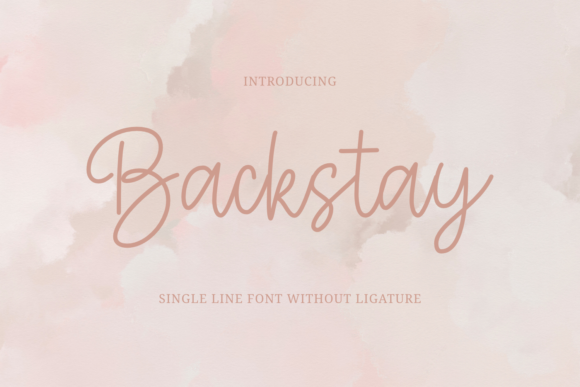
Backstay Script Font for Handmade Branding
There’s that quiet moment—mid-morning light, coffee cooling beside my laptop—when I open a fresh candle label mockup and realize the font isn’t *quite* right. Too stiff. Too formal. Too… not *me*. That’s when I reach for Backstay: a Script Handwritten font that feels like handwriting with intention—casual but confident, relaxed but refined. It’s the kind of Fonts choice that doesn’t shout, but still makes people pause.
Backstay for Candle Labels and Hand-Poured Product Packaging
I tested Backstay on soy wax candle labels last week—“Lavender & Rain,” “Coastal Sage,” “Honeyed Amber”—and the difference was immediate. The soft entry strokes, gentle slant, and airy spacing gave each name warmth without sacrificing legibility at 12 pt on a 2” x 3” kraft sticker. Because Backstay is a Script Handwritten font built for real-world use, it holds up beautifully in print: no thin hairlines collapsing, no awkward joins when cut on a Cricut or Silhouette. I paired it with a clean sans serif (like Montserrat Light) for ingredients and burn instructions—Backstay handled the product name, and the pairing felt intentional, not accidental. For handmade sellers, that consistency between label, website banner, and Instagram story is where brand trust begins.
Backstay for Wedding Invitations and Elegant Branding
When a friend asked me to design her wedding suite—digital RSVP cards, printable place cards, and a welcome sign—I opened Backstay first. Not because it’s fancy, but because it’s *human*. Its relaxed rhythm echoes the ease of handwritten calligraphy, but with the reliability of a well-engineered Fonts file. I used the standard weight for names (“Emma & James”) and swapped in subtle swashes for “Est. 2024” on the back of the menu card. No extra plugins needed—just clean OTF files with OpenType features ready to use in Canva, Affinity Designer, or Illustrator. As a Script Handwritten typeface, Backstay shines in short-form elegance: ceremony titles, monograms, date lines—not paragraphs, but presence.
Backstay for Printable Wall Art and Digital Downloads
I added Backstay to three new digital wall art designs this month: a minimalist “Breathe” quote, a botanical-themed “Gather Wild Things,” and a cozy “Home Is Where the Light Is.” Each one uses Backstay as the sole display font—no secondary type needed. Why? Because its natural variation in stroke width and organic baseline shift gives movement and texture, even in static PNGs or PDFs. Buyers told me these prints “feel handmade,” even though they’re digital downloads—and that’s exactly what a thoughtful Script Handwritten font delivers. Just remember: for small-format prints (5x7” or less), keep line spacing generous and avoid ultra-thin shadows that muddy the script’s delicate curves.
Backstay for Tote Bags, T-Shirts, and Merchandise Design
Cutting Backstay for heat-transfer vinyl on cotton totes taught me something practical: this Script Handwritten font loves breathing room. I scaled “Good Things Grow Here” to 1.8” tall and left ¼” clearance around every curve—no tangled corners, no lifted edges after washing. For screen-printed tees, I stuck to single-line phrases (“Hello Sunshine,” “Made With Love”) and avoided tight kerning on letters like *f*, *t*, and *y*. As a commercial Fonts purchase, Backstay includes full licensing for physical products—no extra fees, no hidden limits. That peace of mind matters when you’re batching 50 mugs or prepping holiday sticker sheets.
Backstay for Greeting Cards and Seasonal Craft Designs
Last December, I designed a set of holiday greeting cards using Backstay for “Warmest Wishes,” “Joyful Moments,” and “Merry & Bright.” What surprised me wasn’t just how well it printed on textured cardstock—but how naturally it paired with hand-drawn holly sprigs and inked borders. Backstay doesn’t compete with illustration; it complements it. Its casual energy balances ornate details, and its relaxed posture keeps seasonal messaging feeling sincere, not salesy. For Cricut users: test cut a single word first at your machine’s recommended settings—Backstay’s consistent vector paths make it highly compatible, especially when exported as SVG from design software.
Backstay for Boutique Tags and Handmade Shop Branding
My linen boutique tags—folded, twine-tied, stamped with a tiny leaf motif—needed a font that whispered “handmade,” not “mass-produced.” Backstay delivered. I used it for shop name + item name only (“The Hollow Press • Linen Napkin”), keeping everything under 30 characters so it stayed crisp at 8 pt. As a Script Handwritten typeface, Backstay adds tactile personality to packaging without demanding attention. And because it’s a fully-featured Fonts family, I reused the same file across Shopify banners, email headers, and thank-you notes—building cohesion across every customer touchpoint, quietly and consistently.
How to Use Backstay With Confidence Across Projects
Before finalizing any design, I always check three things: First, that I’m using the OpenType version (for automatic ligatures and stylistic alternates). Second, that my file format matches the output—OTF for cutting machines, WOFF2 for web previews, TTF if embedding in Canva templates. Third, that I’ve reviewed the commercial license—it covers unlimited physical products and digital downloads, which means I can safely include Backstay-styled text in editable Canva templates or layered PSD planner pages. It’s not just another Script Handwritten font. It’s a reliable, expressive, quietly versatile Fonts tool—one that grows with your shop, season after season.